Adoption
One small step for a dog, one giant leap for your family: Mission Adoption
Congratulations, Command! Deciding to adopt isn’t just a big gesture – it’s a genuine jump into hyperspace. Your heart has just grown by one ball of fur, and a new, tail-wagging passenger has checked into your home.
Time for a reality check, though: adopting a dog from a shelter isn’t a perfect advert where the dog jumps straight onto the sofa and thanks you for the rescue.
It’s a high-risk logistics operation. To your dog, your home is a “New Planet” – fascinating, full of strange smells, but also frightening. And you are no longer just an “owner”; you’ve become a Guide, and the success of this mission depends on you.
“This mission isn’t about the dog being obedient. It’s about the dog feeling that its new planet is the safest place in the galaxy.”
STATUS: Systems ready for launch
If you’re ready to start Mission Adoption, run one last crew check. Fasten your seatbelt, make sure your “on-board computer” KeeVet is active and ready to log data, and let’s begin the landing procedure.
Mission objective: Stabilise the new passenger in an alien ecosystem.
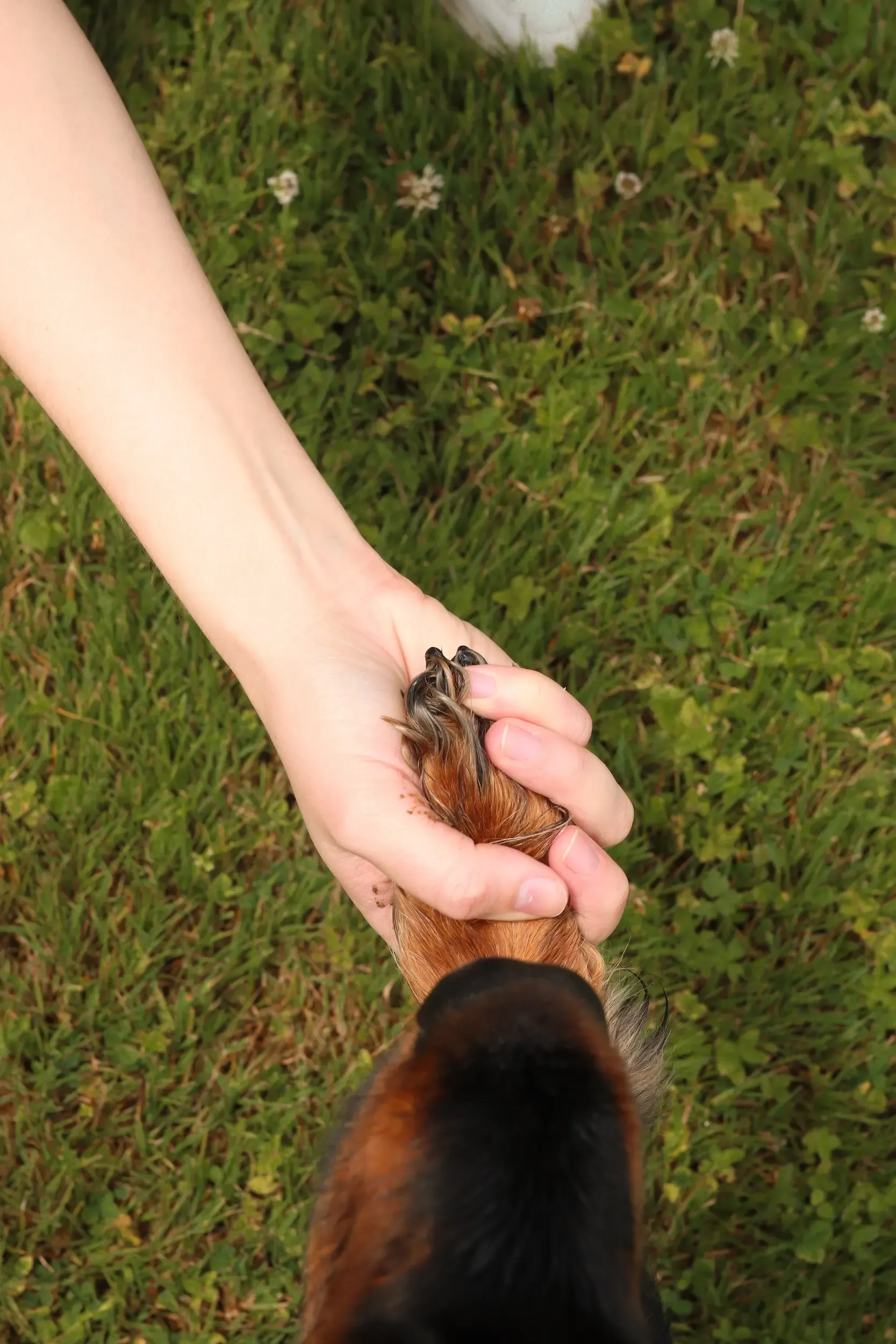
In our system, offering a paw is more than a gesture – it’s the official approval of the trust protocol.
Managing the first 24 hours: the “Zone Zero” procedure
Imagine you’re a pilot who has just crash-landed on a planet where gravity doesn’t work and the oxygen smells like something you can’t identify. Your radio is crackling, the lights are flickering, and you don’t know whether the locals reaching out to you want to rescue you or take you apart.
That’s how a dog feels in the first hour after crossing your threshold. It isn’t a joyful “welcome home”. It’s survival in a storm of information.
Signal analysis: why “radio silence” is essential
To a dog, your home starts out as a giant collection of unknown and potentially threatening signals. Every creak of the floor, the smell of washing-up liquid or the hum of the fridge is a separate message that its overstimulated brain has to check for danger.
- Command directive: no visitors. Forget the housewarming party or showing the dog off to family and neighbours. This is not the time for guests.
- Processor overload: Introducing strangers, excited children and forced play with new objects will make the system simply crash. The dog may freeze (hibernation) or, on the contrary, become destructively hyperactive.
- Your job: Environment Stabiliser. Become an “acoustic screen”. Turn off the TV, silence your phone, keep loud conversations to a minimum.
- Goal: Safe Boredom. Let the first day be as boring as a flight through an empty galaxy. In dog language, boredom is the most important signal: “Nothing will attack me here, my systems can rest.”
Anchor in space: building the Mother Base
In space, the most important thing is the docking station – a place where systems can reboot. In your home, that station is the dog bed. But careful: it can’t be just any corner.
Here’s your action plan:
- Strategic location: Place the bed so the dog can watch the door from a safe distance while staying out of the main thoroughfare. This Base must be an oasis of calm, a refuge where nothing forces the dog to interact.
- The NF directive (Nothing Forced): This is your sacred rule. When the dog retreats to its base, it becomes invisible. You lose your interaction privileges. You don’t touch it, call it or “comfort” it. Let it be an observer. Once it feels it controls the space from a safe distance, its heart rate will drop.
The KeeVet app: your digital logbook
Before emotions take over, launch your command support system. Download KeeVet – your personal “black box” and data centre for the new passenger.
- Objective: your first task after landing is to enter the key parameters: vaccination dates, the last deworming and the doses of any medication
- Why? Shelter documents tend to disappear into “black holes” during moves and base reorganisations. By transferring them to the KeeVet digital cloud, you get access to the medical history in a split second – even if you suddenly need to visit the nearest medical station (the vet)
- Result: You can focus fully on building a bond while KeeVet keeps track of the dates of your dog’s next “biological services”.

The 3-3-3 rule for dogs: phases of settling into a new home
A dog’s adjustment is a process with its own unique pace. Don’t expect full operational readiness in the first minute after landing. Understanding the 3-3-3 Rule is a key protocol for every Commander, helping you stay calm while your dog’s systems need time to calibrate.
First 3 days (decompression)
- System status: This is the shock phase. The dog may not eat, may hide in corners or sleep through whole days (“hibernation”). It’s time for a system reset after a huge change.
- Your tasks: Don’t force interaction. Just be nearby without imposing yourself. Speak in a calm, steady voice.
3 weeks (calibration)
- System status: The boundary-testing stage. The dog starts to understand the household routine. As it gains confidence, this may show up as barking, chewing things or checking out the bin.
- Your tasks: Introduce clear, consistent rules. Remember that routine is a language that gives your dog a sense of security.
3 months (integration)
- System status: Fully operational. The dog feels part of the crew. It trusts you completely and knows the rules on board.
- Your tasks: This is the perfect time for advanced training, building a deep bond and planning adventures together. Now you can set off to the end of the world and beyond!
TIP: Remember that every dog has its own biological clock. The 3-3-3 Rule is a map, not a rigid timetable. Be flexible and adapt the plan to your dog!
Building trust: how to talk to an “Alien”
Making contact with a being from another world takes patience and close observation of its communication systems. Instead of imposing your presence, become a predictable supplier of resources.
Treat diplomacy (the stomach strategy)
Building an alliance with your new passenger works best through its stomach, but it has to happen on its terms.
- The “Safe Drop” technique: Instead of feeding the dog straight from your hand, which a fearful animal may perceive as “aiming a weapon” or invading its personal space, toss treats on the floor next to it.
- Peace signal: This sends a clear message: “I mean well, and I don’t expect anything in return”. It builds trust without pressure for direct contact.
- Strengthening the bond: This is your insurance policy – the dog starts to associate your presence with something positive, which lowers its alert level.
The sniffing mission (gathering reconnaissance data)
In the first phase of the mission, a walk isn’t obedience training or a race against time – it’s the most important reconnaissance operation.
- Action: Let the dog sniff every tuft of grass for as long as it needs. It sets the pace of the mission.
- Data analysis: For a dog, sniffing is the equivalent of “reading the morning paper” and mapping the terrain of the new planet.
- System stabilisation: Intensive sniffing is a natural way to lower heart rate and stress levels. It helps the dog feel more confident in an unfamiliar ecosystem.
Emotional cooling system (the safety valve)
When stress levels in the dog’s processors get too high, it needs a mechanical way to release the tension.
- Natural endorphins: Chewing, gnawing and licking are natural “safety valves” that release feel-good hormones (endorphins).
- Solution: Instead of letting the furniture (part of your shared base) “disintegrate”, give the dog safe natural chews, lick mats or Kong-type toys filled with food.
- Reset: These activities let the dog reset its system after a day full of new, intense impressions.

Ciri sleeps so peacefully because she knows that, as her new Commander, you’ll put the best care strategy in place for your furry passenger.
As a Guide, you need to learn to recognise the signals that your dog’s systems are overheating. They’re often subtle:
Alarm signals (signs of stress)
- Nose licking and lip smacking: A common calming signal sent to the surroundings.
- Yawning: If the dog isn’t sleepy, yawning is an attempt to release inner tension.
- “Whale eye”: Showing the whites of the eyes when the dog turns its head away but keeps watching you.
- Shaking off: It looks like shaking off water – the dog is literally “shaking off” excess emotion after a difficult situation.
Health and stress: handling emergencies
Plumbing failure (accidents in the house)
A stressed dog may have an accident indoors. It’s not spite or “bad manners” – it’s a biological reaction to stress or excitement.
- Reaction: Ignore the incident. Clean up without a word or a shout. TIP: Use an enzymatic cleaner to get rid of the smell
- Reward: Celebrate every success outside as if you’d just landed on the Moon for the first time (treats, praise, play!).
Technical inspection at the vet
Within the first 2 weeks, visit a biological mechanic (the vet). The adrenaline after adoption can effectively mask pain and hidden faults. You need professional confirmation that all components are working properly.
- Specification for Young Cadets (puppies): If your new companion is a puppy, the service calendar is much busier. You must strictly follow the schedule for upgrading its immune shield (the vaccination series) and regularly neutralise parasitic “stowaways” (deworming). In puppies, the defence systems are still calibrating, so any gap in biological protection could put the whole mission at risk.
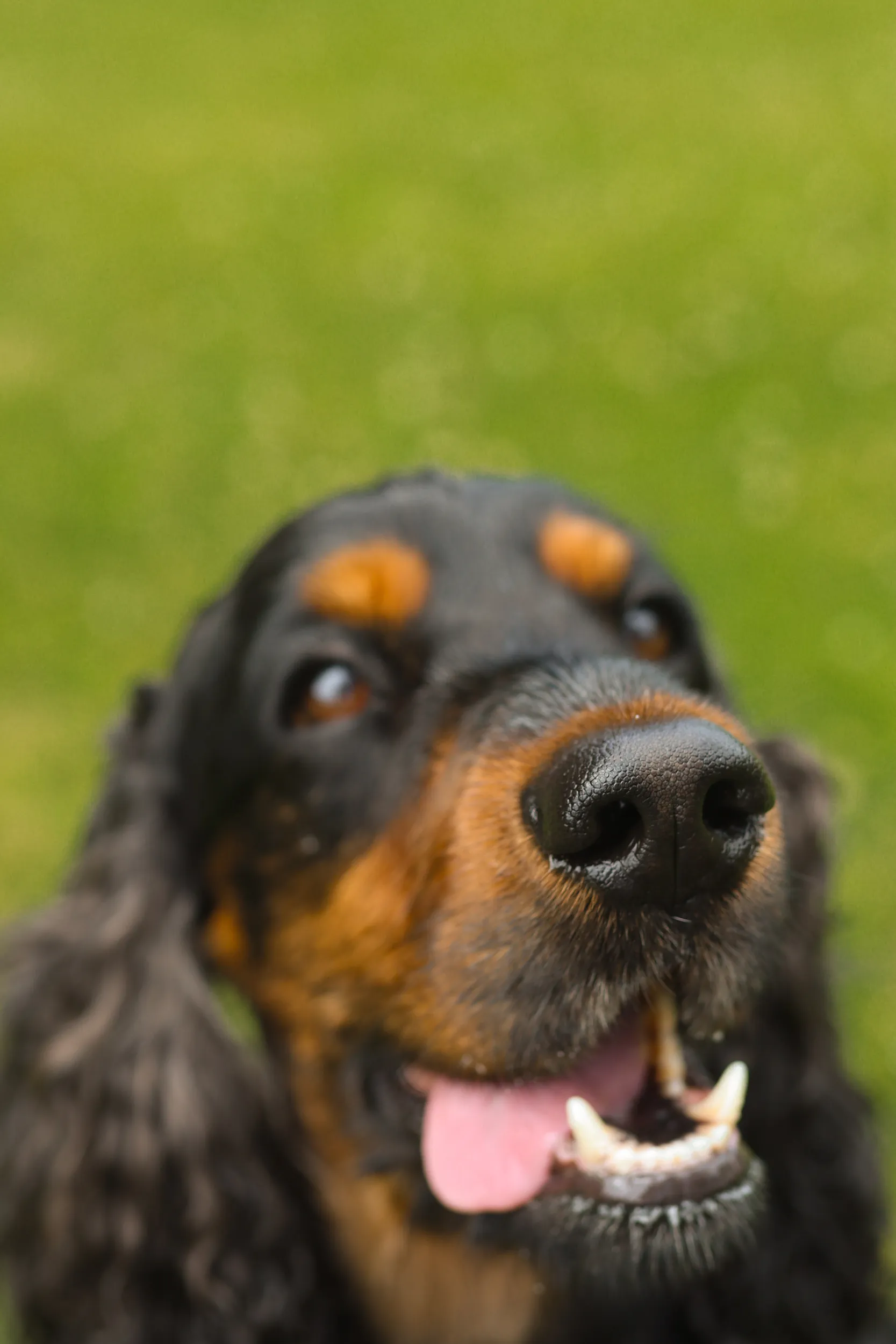
Ouzo has completed the full procedure for switching to a new high-protein turkey blend. Thanks to the gradual transition protocol, his digestive systems run without the slightest disruption.
Fuel (diet and digestion)
Proper refuelling is the foundation of every system’s stability. Don’t change the food in the dog’s first days at home. A digestive revolution combined with post-landing stress is the last thing you need on your base.
- Fuel change protocol: If you plan to change the diet eventually, do it gradually, mixing old and new for at least 7 days.
- Mixing schedule: Increase the share of new food by 25% every 2 days in this pattern: 75/25, 50/50, 25/75, until you reach 100%.
- Goal: This procedure helps avoid sudden breakdowns and digestive problems.
Choosing refuelling equipment: What you serve the meal in is just as important as what you serve. At the start of the mission, skip metal bowls. For many dogs (especially those with a difficult past), metal bowls can be a source of fear for several reasons:
- Noise: The sound of an ID tag or collar hitting the bowl can sound like a battle alarm to a dog.
- Reflections: Polished metal reflects light and movement, which can confuse the animal while it eats.
- Vibrations: Metal bowls often vibrate slightly on hard floors, which puts the dog off the bowl.
Solution: Choose heavy ceramic bowls or stable plastic ones. They’re quiet, stable and don’t turn food into a “suspicious object”.
YOU are the Captain of this Mission (but you have our support)
Adoption is a marathon, not a sprint through hyperspace. Remember that mistakes will happen – both to you and to your new passenger – and they’re a natural part of calibrating your life together. At those moments, the key is for your inner “navigation system” – based on patience, knowledge and love – to work flawlessly.
Over time, the initial information chaos will turn into a beautiful, predictable journey full of trust through the galaxy of everyday life.
Download KeeVet – your Peace-of-Mind Assistant. Because even Captain Kirk needed an on-board computer to explore unknown worlds and keep his crew safe.
- Don’t let important information about your dog’s health disappear into a black hole of forgetfulness.
- With KeeVet you have everything under control, so you can focus on what matters most: building a bond.
Do you like KeeVet?
Now you too can help build this project and support hundreds of owners in their everyday interstellar challenges! Your support on Patronite is extra fuel that lets us:
- Expand the systems of your digital logbook with new, smart features.
- Reach people with practical help as they prepare to land their very first doggo.
- Build a community of thoughtful guides for whom the safety and happiness of the crew come first.
Become our Patron and help us make every dog mission safe, predictable and full of love. Together we can do more!